How Anime is Made: A Comprehensive Guide
Preface: I had this document published on my Twitter page when it was originally written in 2023. I'm republishing is here so that it's up. I've had a lot of positive reception about this document and it acts as a great starting place for anyone interested in jumping into the world of Japanese animation. Enjoy!
The Japanese anime industry is a wonderful place full of inspiration, interesting people, and endless opportunities for artists. For artists to be able to join the Japanese animation industry from abroad they first need to understand how anime is made.
This document will introduce a lot of Japanese industry specific terminology that will be useful for self-studying on your own. My recommendation is that you use Japanese terms as they are used in the industry to discover the processes you are most interested in learning. When you find a website that seems interesting to you, there are many tools available to translate that information .The most frequently used would be Google lens, Google translate, ChatGPT and DeepL.
The process of anime creation is very complicated and overwhelming at first. The goal of this document is to provide the foundation for anyone to learn about the anime industry. This will go over the process of anime creation from beginning to end. This video will be an essential starting place for anyone who is interested in creating anime and participating in this vibrant industry!
Originally this was going to be an outline for a YouTube video, but I for now I’m just releasing this as a text document to hopefully benefit anyone interested in learning unknowns about Japanese anime. Likely this will spawn the creation of content that’s more accurate on youtube about the anime creation process so I hope this is a good resource for anyone. Feel free to use the content in this for your own video, just please credit this as a source in your video descriptions. This will be a living document and new revisions will be added and published on Jarrett’s twitter account if additions are made. Latest version: 10/2/2025
スタッフ(Staff):
To begin I would like to introduce all of the staff and job titles of people who make anime happen. These people will be referenced multiple times throughout the document. Roles in anime production are relatively fluid as many people hold multiple titles across productions, and aren’t necessarily fixed onto one title.
Departments:出資会社\製作員会メンバー会社 Investment/Production Committee Companies
The Seisaku Iinkai/Production Committee is the committee of member companies, investors, and producers that finance and greenlight anime productions. Usually the committees are primarily composed of Maker companies. Maker companies in Japan are large companies that produce products. Maker does not refer to craftspeople like in the US.
メーカプロデューサー/エグゼクティブプロデューサー: Executive Producer: Guarantor of Funds and project representative
ビデオメーカー: Video Maker
レコードメーカー: Record Maker
ゲーム会社: Game Company
映画会社: Movie Company
TV局: TV Station音楽制作会社: Music Production Company
出版社: Publisher
広告代理店: Ad Agency
玩具・グッズメーカー: Toy/Goods Maker
遊戯企業: Pachinko/Arcade Companies
アニメ制作 (Sometimes): Anime creation company
Leadership:
Individuals that interact with every department and every stage of the production.
プロデューサー/ラインプロデューサー製作担当: Lead producer that arranges the project and brings the various people together to create an anime project. In charge of managing & building the production site, determines main staff, manages quality , schedule, and budget. They help with all other positions in the department.
監督: Director of the film. Involved from the Scenario stage all the way through the final edit of the animation. Directors are usually not a member of the studio that is creating a production and usually they are a freelancer who is brought on for the specific project.
制作部 Production Department:
Production Team:
The production team is in charge of taking the anime project from beginning through completion and delivery.
制作進行 Production Manager: Manages the progression, file management, and ordering of Sakuga assignments from Layout through Satsuei. Does quality checks, progress reports, answering phone calls and emails, scans and delivers cut materials, and updates management about project progression. Sometimes selects animators for work, a high stress and high responsibility position.
制作デスク Production Desk: A person, not a desk, who manages the schedule, quality, and budget of work by coordinating the 制作進行. Desk in Japanese titles refers to the main point of contact, department secretary, or a department.
設定制作 Seisaku: Position to produce materials for world development, ordering and managing the creation of design materials. Seisaku will also manage the production of the Ekonte. Seisaku, while in charge of producing materials, is most similar to the role of assistant director in the west.
演出:Unit director / Episode director. This position directs acting, visual images, etc. to each section based on the storyboard. Attends meetings and checks throughout the entire production process of his/her episode (of movie section) only.
文芸部/Writing Team:
The writing team is in charge of developing the world, story, characters, and writing the scenario. This term is used in some companies in Japan, but there is no officially agreed upon term for the Writing team.
シリーズ構成作家: Head Writer or Leader of the screenplay team in charge of the larger picture of the entire series.
脚本家:Position to create series and episode plots, as well as scenarios.
シナリオライター:Person who writes the scenarios for episodes or movies in anime production. Generic term for anyone who participates in this process. It’s not a hierarchical position.
Administration:
Anime studios are businesses so the following individuals or departments are necessary to handle taxes, bookkeeping, contracting, HR, PR, and other miscellaneous business operational procedures. Not all anime companies have people in-house in all of these roles.
経理: Accounting
総務: General Affairs
版権管理: Copyright Management
営業: Sales
広報: Public Relations
通訳: Interpreter
人事:HR
作画部 Sakuga Department:
Sakuga is the term that describes the drawing and painting component of anime production. This term is misused on the internet to mean high action animation, but it literally is just the term for the process of creating animation in Japan. Sakuga Department is in charge of animation and design work.
原画: Key Animators作画監督: Sakuga Director/Sakuga Supervisor
動画: Clean up and inbetweening
動画検索: Douga supervisor
キャラクターデザイン原案: Character Design
メカデザイン: Mecha Design
プロップデザイン:Props design
色彩部: Coloring Department
The coloring department is in charge of color design and cel painting. In the past it was done by painting onto xeroxed or painted onto clear celluloid. Since the 90s its all been transitioned to digital painting.
色指定: Specifies the character color for each cut according to the design色彩設計: Color Design: Decides the colors of the cel designs based on the art boards/concept art仕上げ: Cel Painting
色検査: Inspect colors for mistakes during the project
美術部 Art Department:
The art department is in charge of painting and creating the art design & direction, background paintings, and 3d backgrounds.
美術設定: Art designer
美術監督: Art Director
背景: Background Painter
3DBG: 3D background creator
CGI Department:
The cgi department is in charge of 2d motion graphics, computer animations, 3d models, rigging, texturing, rendering, 3d design, and software engineering. This can be in-house in larger studios, or outsourced for smaller studios. Almost all anime productions are using 3DCG in some form.
2DCG:2D Effects Creator
3DCG Generalists: Most people in 3DCG Studios and departments will be involved in most areas of 3DCG production.
モデリング: Modeling
UV展開: UV Mapping
テクスチャー: Texturing
リギング: Rigging
3Dアニメーション: 3D Animator
レンダリング: Rendering
モーションキャプチャー: Motion Capture
レイアウトLayout:Lighting:
エンジニア: Involved in the development of software and plugins to improve the visual expression and development environment for the production
CGI監督: CG Director
スペシアルエフェクトスーパーバイザー: Special Effects Supervisor
撮影部 Compositing Department:
The compositing department is responsible for bringing all of the materials of the art departments together to create a cohesive image to be used in the final delivery.
2dコンポジット: 2D Composite: Assembles cuts based on instructions and precautions given to them from 2D Sakuga, the Screen Designer, and Compositing Director.
画面設計: Screen Designer: Designs the presets and style of compositing for the production.
撮影監督: Compositing Director: In charge of determining the visual style along with the screen designer, and acts as the primary supervisor and quality control for the compositing. They are the leader of the compositing department.
編集 Editing Team/Company:
Editing department works to compile the visuals, audio, master files to create the CT movies, and the final deliverable video file.
編集アシスタント: Equipment operations and auxiliary work according to editor instructions
編集: Create the CT Movies with the Kantoku/Enshutsu. Must have a strong artistic sense for image and timing. V編: The person who creates the master video file,does the technical editing for time slots, audio syncing, editing credits, and adding in the opening and ending sequences.
音響制作 Sound Production Company:
The sound production company is usually an external group that is in charge of producing the music, voice acting, and sound design for a production.
SEアシスタント: Gathering sounds needed for the production and assists in production
音楽アシスタント: Sound Assistant
サウンドデザイナー: Creates sound effects appropriate for the scene and direction of sounds(such as environmental sound).
音楽家: Create original tracks to fit the mood of the scenes OST music also known as 作曲家 (music composer)
音楽プロデューサー: Hires composers and manages the production and budget of music creation. OP ED Theme song, etc音響監督: Casts voice actors with kantoku, performs AR recording, produces SFX, original score, and any other audio needed for the production. Leader of the sound team.
音響プロデューサー: Makes arrangements, AR, for sound effects, and music production. Coordinating voice over, music, sound effects.
録音書手: Manage the sound board and equipment while recording
声優・俳優・女優(Antiquated) Voice Actors:
Voice actors are external contractors that work to create and develop the voices necessary for anime production.
Voice actors and actors who participate in the creation of the vocal acting for an anime production
The Anime Creation Process
企画書(Pitch Document)
Preliminary 企画書: First version of a pitch document that is created after conversation of an idea for a project. Kikakusho are not made casually and are taken very seriously as something that has a high likelihood of working out. This first version of the kikakusho will have a small budget to pay designers and writers to come up with the idea, and present it to an executive producer. This is usually commissioned by a producer or committee.
Format and budget will be suggested here. If the pitch gets the interest of a production committee, then the project is going to be greenlit. After this stage the pitch will go under further development to make it interesting to the people who can form the production committee.
Often originates from a director, writer, or producer that wants to make an original idea.
Can also be an animator with ideas. Names of the core staff are very critical for the pitch to be effective.
There are some companies that specialize in creating this document.
Core Staff will be suggested here and paid to work on developing the pitch. In Japan pitches are only picked up internally in the industry. Pitches aren’t taken by people who are outside the industry. The only exception to this is external contests. Though companies are very hesitant to do this. Internal contests are much more common.
Main企画書:Committee
Format and budget will be finalized here. The characters, story, and pitch will be finalized so that all parties involved (committee members and creators) are happy with the direction.
Pilot: Created only if the kikakusho isn’t enough to convince a production committee to pick up the project. Often the pitch is strong enough that a pilot isn’t needed.
Core staff will be expanded at this stage.
If your dream is to make your own anime; the only way to get your show picked up is if you join the industry and start making anime. You have to put yourself in a position where you can be listed on a Kikakusho, or you need to have the financial resources and connections to be an executive producer.
These projects and staff are gathered through trusting relationships and friendships (dinner and drinks) rather than through agencies.
製作員会メンバー会社 Production Committee System
The production committee system is the financial modeling for the anime industry.This is a system where people from varying companies and investment firms in Japan come together to finance anime projects. Each company will invest into the production in exchange for various upsides of the production. This includes music rights, distribution rights, merchandising rights, advertising revenue, residuals, and any other thing that can be negotiated and accepted by the committee when the committee forms. Anime is a very profitable industry for investors and all of the stakeholders have a lot to gain financially by investing in anime. If you’re interested in learning about the complexities of the Seisaku Iinkai system please check out this video. It’s also important to stress that it's different combination of companies for different shows which creates the production committee.
Exceptional case: Some companies will finance 100%
イメージボード
The very first concept art for an anime idea. Often these are used in pitch documents at an early stage in the production to secure the essence of the anime idea, and to inspire the staff about the production. This can happen before or after the scenario is created.
Image boards can be drawn by the director, the character designers, or other members of the design team.
シナリオ
The blueprint of the anime. The scenario can be in the form of prose, a script, or outline. The scenario determines the character, story, locations, and plot. The scenario is final.
脚本家/シナリオライター (Kyakuhonka/Scenario Writer)
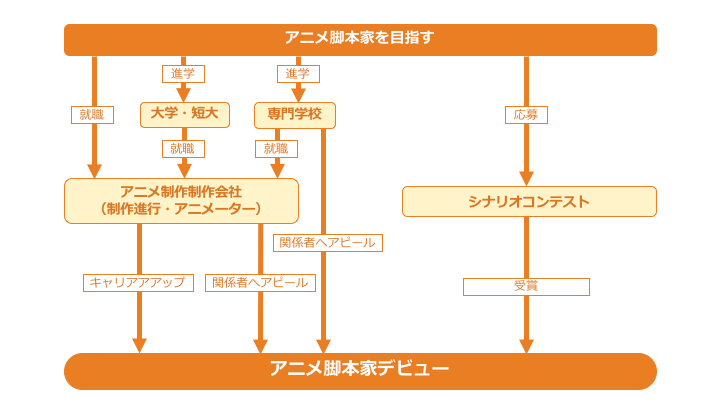
The person that creates the scenario. To become a scenario writer you would start as a 脚本家の弟子. To join the writing department, typically you need to join the production team as 制作進行 and appeal to be on the writing team. The 設定制作 is a common person to join the writing team because they are involved in much of the planning and development stages of anime. It’s also possible to become a scenario writer by submitting to competitions.
https://www.amgakuin.co.jp/contents/animation/column/tips/scenario/
シリーズ構成作家(Series Kousei)
Head Writer or Leader of the screenplay team in charge of the larger picture of the entire series.
文芸部 (Bungeibu)
Group of writers in charge of working with the Producer and the Director under the シリーズ構成作家. Apprentices can come from everywhere, but usually they come from the Production Department.
シナリオ会議(Scenario Kaigi)
Meeting between the leadership of the project to determine the story and goal of the anime.
This group creates the range of the story and divides it into 12 episodes (number of episodes is determined by the budget, ambition of the project and broadcasting time slots). They will discuss the brief outline of the シリーズ構成(Series Kousei): The flow chart or spreadsheet for the progression of the anime. This is created by the writers and reviewed at these meetings. 1 (Season) cour series have between 11 and 13 ep, 2 cour series have around 24~26 ep. The word cour originates from the French word for quarter; which is used in Japanese broadcasting slang.
Then they will discuss each episode individually.本読み (Honyomi)/Table Read is the meeting where members read the latest version of the episode scenario and discuss it. The scenario will be approved, or producers and director will give indication to the writer so that he can modify the structure or dialogs of the scenario.
The meetings will take place every time a new script is written. Usually once per week or every 2 weeks at a regular time slot. A scenario is usually written over a period of a few weeks. The main writer usually creates the first and last episode. The rest of the episodes will be split among 2-3 writers シナリオライター. The meetings will usually go over multiple episodes at once to help minimize the production schedule.
The scenario needs to be completed quickly though so the ordering of materials can begin. The scenario can’t move on until it’s approved by the メーカーのプロデューサー and original creator.
絵コンテ
Econte: Japanese film production slang which means Drawing絵 continuityコンテ. It’s a document that determines the camera angles, shot length, shot count, and actions of characters. The e-conte is final. Usually and ideally the 監督 or 演出 creates the 絵コンテ. 制作 staff use the 絵コンテ to create the shot list, cut number total, and the length of the video. In the case a series ep it has to follow a very strict format. http://animenobutaiura.seesaa.net/article/429503949.htmlTV Format Example:Avant: X seconds
OP: 90 seconds
Pre-offer: 10 seconds (Sponsor bumper)
CM1: 60 seconds
A part: Y seconds
CM2: 60 seconds
B part: Z seconds
ED: 90 seconds
CM3: 60 seconds
Notice: 30 seconds (Teaser)
After offer: 10 seconds (Sponsor bumper)
End card: 5 seconds
X + Y + Z = 1260 seconds (21 minutes)
アバン:X秒
OP:90秒
前提供:10秒
CM1:60秒
Aパート:Y秒
CM2:60秒
Bパート:Z秒
ED:90秒
CM3:60秒
予告:30秒
後提供:10秒
エンドカード:5秒
割り振り表(Warifuri hyou)
The 制作 creates a grid to section the animation into pieces that can be handled by individual animators, the sections are handed out strategically to animators based on their skill sets and passion.
絵コンテ打ち合わせ (Econte Uchiawase)
This meeting is to discuss the creation of the 絵コンテ。監督 can start on his episodes 絵コンテ、 but it’s unlikely for them to board every episode
An example:https://en.wikipedia.org/wiki/List_of_Guin_Saga_episodes
The entire series was storyboarded by Atsushi Wakabayashi, Satoshi Kon also did all of the boards himself.
制作 will call 絵コンテマン to create the remaining episodes. The meetings will be to discuss how the storyboards should be made. Ideally 絵コンテマン is 演出. Sometimes 作画監督 will create 絵コンテ and do 演出 which is rare, but can create really high quality anime. Kantoku will explain the scenario and focal points of the story for the 絵コンテマン to understand. The 絵コンテマン will ask questions at this meeting about clarifying points. If they have questions after the meeting it’s usually handled over the phone/ web call.
絵コンテ監督チェック
Kantoku evaluates the storyboards, and must approve them for the boards to move on to production. If something is wrong with the e-conte the director is redrawing panels and sometimes entire sequences by themselves.
絵コンテメーカーチェック: Optional
In the case that the Maker Company has requested approval rights on production, the Maker has to approve the Kantoku afterwards to make sure the contents of the episode are correct to air on TV.
After the approval the storyboards are finalized, and will not change.
制作 (Seisaku) will then number the cuts in the animation and distribute copies to the entire leadership team. They will also make a tentative schedule based on projected workload. Creating the schedule is done by experienced staff who understand the entire process of creating anime. Usually they work backwards from the deadline, and using their experience and strategy they will determine approximately how long each stage will take; including plenty of extra time for retakes or deadline extensions. The schedule will never go as planned, and everything can and will go wrong. Creative blocks, natural disasters, family deaths and illness, laziness, geopolitics, computers crashing, and mental health issues are some of the infinite factors that will affect the production schedule. It’s very important to have plans and plenty of extra space in the schedule for when things go wrong.
絵コンテ then is distributed to everyone on the production.
設定
Creation: Determines the style of the show and how to draw all the characters, props, and backgrounds. This is necessary to unify the style of the animation.
Character design (キャラ設定)
In the case of an adaptation : the character designers establish the model sheets (rough, then clean) with all of the details necessary for the animators to handle.
In the case of an original anime. Sometimes the work is split between character 原案(original concept) made by a creative person /skilled designer, often a popular illustrator. Then the アニメーションキャラクターデザイン. A very technically skilled animator adapts the original character design into a model sheet that the full team can handle.
Prop design: Could be done by an animator or illustrator.
Mecha design: Need specialists to create Mecha. eg. Kimitoshi Yamane, Takayuki Yanase
Character, Prop, Mecha Settei: ラフ(Designer)→清書(Designer)
Character/Prop Settei: Rough → clean copy
Art Settei : Rough → clean-up → art board (normal) → art board (change of time zone)
Background design (美術設定): basically only line art of every location.
美術設定:ラフ(Designer)→清書(Designer)
Key color backgrounds (美術ボード)Basically this consists of painting the 美術設定
Handled by the 美術監督, most of the time a different person than the artist in charge of 美術設定。Sometimes different painting are requested for the same location (day, night, sunset etc.)
Color design (色彩設計) ONLY FOR CELL ELEMENTS
The color designer defines the base colors for all elements drawn on cell by the animator (Characters, props, mecha).
Then the color designer creates a new set of colors according to the different locations and time zone. Interestingly, this is done manually color by color and not handled by compositing filters (often the case in the West). But, compositing artists will be able to further enhance the result with color grading filters in post production.
Difference between adaptation and original anime:
With adaptation it goes straight into settei.
For original anime there is a conceptualizing phase.
原案: Early conceptualizing stage usually done by non-animators/designers who are aware of current trends, fashion, and art style. This stage is where some of the first images of the character are created.
シナリオ香盤表
A preliminary Koubanhyou is created after the scenario is completed. Some settei can be derived directly from the Scenario.
香盤表:
Final Kouban Hyou is created after the E-conte is finished. 制作 will use the 絵コンテ to create a reference sheet to describe the special needs of each shot: This can include settei needs, lighting, seasons, any additional notes needed per cut. When, where, what, and who. Animators will reference this sheet when working. This sheet is also used to help create the material packages for the animators. 制作 meets with the 監督、 制作デスク to fill out the remaining settei that the 制作 missed. The 演出 determines what settei isn’t obviously needed. This group also decides which settei needs drawings and which are okay to use photo reference. If photos are determined, the 制作 and other staff may go location scouting to gather photo references for the settei.
The settei will then be ordered to create for each episode.
美術設定: Background and Location Designs
小物/プロップ設定: Prop designs
キャラクター設定: Character Designs
モブ設定: Random characters
表情集: Facial Expression sheet
作画監督修正集: Precaution sheet created with examples from past episodes or work.
注意事項: Precaution sheet created by the animation director or seisaku staff
All the materials are gathered and prepared to be sent to the animators.
演出打ち合わせ:
Meeting to go over the episodes to determine what the Kantoku wants to express in the movie. Attendance: 監督、演出、制作デスク、設定制作、制作進行 are in attendance. There is no meeting if it’s the 監督’s episode.
作画打ち合わせ/作打ち:
Meeting with 演出, 制作進行 and Animators. This meeting gives the animators necessary information needed to successfully create their sections that were assigned to them. Usually anime with good schedules require 15-20 animators per episode, but if the schedule is fast it can be more people. It’s usually never more than 30 animators per episode because the more animators, the more continuity is difficult to maintain. The average amount of cuts for a whole episode is 300, and sections usually contain 15-20 cuts (or about 1 minute of the episode). In this meeting animators can ask questions about their sections, and the director will clarify all of the information so the animators can succeed. Often the case is that the enshutsu will provide some hints or ideas for how to execute the cuts as well. During these meetings directors will often act out the actions they are hoping to see in the animation; which can be very funny at times. Often it’s also the case that ekonte is drawn extremely rough, so the enshutsu will likely have to explain which character is located in the ekonte.
作監打ち合わせ:
Meeting with the 作画監督 to discuss sections, what’s happening in the sections, and what to focus on when correcting the drawings. Style is also discussed and the director will likely give references to anime that are similar in style for the sakkan to reference.
レイアウト/第一原画/ラフ原
Layout is the process of creating the initial rough key animation and backgrounds for anime productions, based on the econte. The layout begins after a section from the Warifuri Hyou is given to an animator, and after the cut bag is assembled. The cut bag can be physical or digital.
カット袋の中身:(Katto Bukuro) Cut Bag Contents
When animations are still in the layout phase, the Cut Bag won’t be a literal bag it will just be the timesheet folded in half with loose papers. In later stages, the literal bag will be used. レイアウト、レイアウトに対する演出の修正指示(演出修正用紙)、レイアウトに対する作画監督の修正(作画監督修正用紙)、総作画監督修正用紙、原画、原画演出用紙、原画作監用紙、動画、色指定、Time sheet
監督の修, Cut settei, CT Sheet, DB corrections (if any)
Econte panel pasted on the outside.
レイアウト・ラフ原画
The animator uses the materials from the Cut Bag/File (provided by the seisaku shinkou) to create the first pass on the key animation with inbetween guides (atari), and spacing charts for all characters,cel animation in the cuts, backgrounds (rough background lineart : 原図), and the x-sheet, (which also includes camera notations, and compositing instructions)
制作チェック
After the Layout is submitted the Seisakushinkou checks the materials for accuracy and completion. If materials are missing, this will result in a retake where the animator will need to correct their work or provide the missing materials. If the quality is too low the cut will be considered NG and the Seisaku shinkou will need to find another animator to take the section.
演出チェック
After the cut passes Seisaku Check, then the enshutsu will do a pass on the layout. The enshutsu will be looking for ways to improve the ideas of the animator by giving suggestions about the acting, animation, posing, framing, composition, and background elements. The enshutsu will also be checking for continuity errors like connected posing between cuts or objects/elements that need to be persistent between cuts. The enshutsu also at this time may decide to divert from the original ekonte or layout entirely, and re-animate the scene for the sake of storytelling, composition, or other reasons. The enshutsu can also call for a retake if there are missing materials, if the animation didn’t follow instructions, or if the cut is NG.
作監チェック
After the cut passes enshutsu check the Sakkan will check the cut. The sakkan’s primary concern is improving the quality and model consistency of the animation to unify the style of the animation. Sakkan will usually also try to make corrections drawings based on the notes from the Enshutsu, to lower the risk of having Genga take care of the corrections. Sakkan will create reference drawings for Genga to follow as a model guide for the rest of the animation.
総作監チェック:
Sou sakkan is usually the character designer and will make corrections on minor details and nuances to help polish the look of the entire production. They are also assigned very critical scenes in the production to bring up the quality. Another role for Sou Sakkan is to handle cuts that don’t have settei available. They will do some design work directly on the layout.
日報(カット表):Daily Reports:
After the Layout production begins the Shinkou staff will begin their daily reports. This sheet tracks the status of every cut of animation for every day of the production. If production staff loses track of this sheet or gets behind in the maintenance of it, it can create duplicate orders, production delays, and crunch time if it’s not managed and monitored carefully.
色打ち、背景打ち/色美打ち:
Meeting to discuss the various lighting situations to align the backgrounds and cel colors. The determinations will all be placed into the 降板表 so the entire production is aligned on the lighting.
Attendees: 監督、演出、色彩設計、色指定、背景、制作進行(制作デスク、設定制作), 色彩設計さん、色指定さん、背景スタッフ. Layout materials will be provided, and background painting work can begin. The reason the paint staff attends these meetings is so the cel colors will align with the background paintings. Sometimes the 色打ち will happen seperately.
CTMovie(Cutting Movie): カッティング
CT Movie will begin creation as the e-konte is finished and revised versions will be created as the production progresses. The CT movie is the most recent edit of all the available materials of an anime production. The CT movie will be used in many cases:
- As a reference for animators to better understand their scenes, in the case an e-konte CT is prepared called the コンテ撮
- As a reference for Afureco, and Sound Effects
- As a reviewing tool for the directors to see if the film is working, storytelling is effective, and continuity is being maintained
Ideally the CT movie contains at least the final colored cels when it’s in Afureco, but this is almost never the case, and often voice acting and sound effects are being done on top of the storyboards. This is due to the simultaneous scheduling and speed of anime productions.
During the process of creating the CT, CT-Sheets are created. These sheets are the first x-sheets created for a cut of animation and contain the timing of the dialogue, the timing of the storyboard frames, camera instructions, and labels related to the project. These sheets are used as a guide for the CT movie editor to know how to create the CT movie, but also so the animators know about the timing of the dialogue, and which materials such as camera pans to prepare.
In CT movies, sections that need dialogue will get a square name that matches the timing of the CTsheet that voice actors will use as their queue for speaking.
原画第二原画
Genga is the stage where the layout, enshutsu, and various sakkan checks are combined to create the final look of the animation to be prepared for Douga.
第二原画: Normally Genga should be completed by the original layout artist, so they already have a base understanding of the work. Often times because the schedule is delayed, the work may require someone to complete Dainigenga. This is separated because of crediting purposes. It’s not always the case that a production would need to create dainigenga if all the Layout artists complete their own genga. In that case all the key animators will be credited as genga. After the Genga is completed it will return to the directors for another round of checks in a similar procedure to the Layout checks:
制作チェック
演出チェック
作監チェック
総作監チェック
This is a breakdown of the key frames based on the correction that came from the first round of genga. All key frames have to be drawn carefully with details containing shadows and highlights. Drawings do not need to be perfectly clean though, because clean up and tracing will be handled at the next phase. But, if the drawings are not precise enough this will result in too much work for the supervisor, douga artists, or in a drop of quality.
動画
Douga is the stage where the final lines from genga and the inbetweens of the cel animation is created. These lines are created in order to prepare the animation for cel painting, but also to finish the animation. The dougaman will first carefully trace and finish all of the genga key frames based on the sakkan corrections. Then on the animator’s remaining drawings. Afterwards they will reference the timesheet, atari, and timing charts to complete the animation. They will then fill in the douga column of the timesheet to re-label and renumber all of the cels based on the final animation. Douga is generally created in Retas Stylos, or Clip Studio Paint. It’s possible to do douga on paper, but it requires a scanning application like the one in Opentoonz. Paper douga is still the norm at many studios as of 2023.
動画検査: Douga Kensa is the last person to check the final lines of the animation. They will either correct issues in the douga themselves, or they will simply circle problem areas and return them back to the douga artist. If there’s no time for douga retakes, they will fix all of the issues themselves, or ask the coloring department to fix the problems when they are doing cel painting (shiage). Douga kensa will be looking out for incorrect/bad inbetweens, and minor issues like gaps in lines, spare pixels, notches in lines, and general draftsmanship issues.
仕上げ
Shiage is the stage where the cel painting from douga gets colored. This is done either in Paintman or Clip Studio. The Shiage artist will paint all the cels in the animation based on the Iro Shitei (色指定) that was created by the color designer and instructions from the lighting column of the 香盤表.
Coloring is done by sampling from the color settei and filling the holes in the lines with a paint bucket tool and other advanced tools present in CSP and Paintman セル検査: Cel Kensa is the person in charge of supervising the cel painting process. They will be checking the work of the Shiage team and working to ensure the quality and accuracy of the cel painting.
背景:Backgrounds
Backgrounds are completed simultaneously with the rest of the Sakuga production. Background work starts immediately after the Layout Enshutsu checks. After backgrounds are ready to start, the Haikei artists will meet with the Enshutsu and the Bijutsu Kantoku in order to understand the content of the scenes, the lighting, and other relevant information that they need to know in order to complete the background paintings. Background paintings are created by following the 原図 drawn but the animator (or enshutsu), using the references of bijtusu settei, and bijutsu board created during pre-production. Background artists are often given very rough or almost non-existent background drawings to start from; so oftentimes they are required to re-draw the background layout before it can be painted.
Sometimes a dedicated staff is redrawing the genzu before the background painting. This step is called 原図整理 genzu seiri.Most background artists work in Photoshop, but some artists will paint in CSP or traditionally. In the case of digital background painting, a lot of stock assets and textures will be used to speed up the production process.
美術監督チェック:As the backgrounds are completed, the Art Director will check all the backgrounds and provide feedback for the paintings and sometimes paint on top of the backgrounds themselves in order to bring up the quality or fix issues like prop scaling, perspective, lighting, and more. 色背撮打ち合わせ:This is a meeting attended by the 監督, 演出、色彩設計、美術監督、演出、撮影監督 and the 設定制作. In this meeting material separations between cels, Backgrounds and books are determined as well as going over the contents of each cut that will be important for the BG, Compositing, and color teams.
撮影: Compositing (Mistranslated as shooting)
Satsuei is the process of combining all of the completed components of the sakuga, background, and CG production to create the final movie that will be delivered and shown to audiences. Almost all of anime compositing is done in after effects; though some productions will do compositing in Retas. Anime compositing is done by assembling all of the files based on the timesheet instructions. Anime cels are timed using time remapping, and not PNG sequences, which is a common misconception about anime production. The reason time remapping is used instead of PNG sequences is because of data transmission issues, and there are advantages to composting this way because it’s much easier to correct timing or replace cels in the case of retakes. Therefore, one of the first tasks of the compositing team is to enter all timing data indicated on the handwritten time sheet.
線撮:(Sensatsu): Line Compositing:
Compositing before the final materials are completed. In progress comp. This is created to have the directors and other leadership team members review the status of the project before douga. It’s also used for sound creation, like SFX, music, and voice acting.
絵コンテ撮: Ekonte Shooting
This is an in-progress compositing that’s created with just the E-konte. It’s often used to help the leadership team visualize the animation, and it’s also useful for voice recording on tight schedules.
レイアウト撮:Layout Shooting
This is an in-progress compositing including the Layout stage. Ideally this is available at a minimum for voice recording in order to avoid doing retakes and allowing the voice actors to add to the performances of the animation so the Enshutsu can make adjustments before the work goes to Genga.
原撮:Genga Shooting
Douga Comp doesn’t really exist. Usually the comp team waits for the shiage to be finished before shooting the final drawings. When materials are missing the comp team will write タイミング on screen in place of the missing materials with a list of missing materials to hold the spot for the cut in the edit. Retakes in comp are tracked with Takes: 1, 2, 3, 4, etc.
撮影打ち合わせ:
This is a meeting to discuss the content of the compositing, the schedule, and issues regarding each cut of animation. They will also discuss which special plugins or strategies to use. Most productions and studios will already have a lot of presets available and custom presets for each production; so most of the compositing work is just about following precise instructions instead of adding any creative ideas.Most of the creative work will have been handled already by the Compositing Director and the Screen designer. The reason for this is that the treatment of the compositing needs to be unified across the entire production. Attendees:演出、監督、撮影監督、 画面設計、2DComposite
アフレコ:
Recording voices for the Animation. This can happen before or after the animations are finished. Usually due to schedule the dubbing is completed before the animation is completed. Sometimes this can result in retakes if the voice actor is able to bring some new dimension to the character that isn’t reflected in the animation.
Attendees: 監督、制作プロデューサー、演出、制作進行、メーカーのプロデューサー、(制作デスク)音響監督、音響助手、効果、声優、音響制作、(声優プロダクションのマネージャー)シナリオライターや原作の先生
What makes the recording sessions in Japan so efficient is that all seiyu in the same room are recording in real time. 2 passes + a few corrections usually are enough which means that one episode can be recorded in less than a couple of hours. All actors for the episode are present for the session, even if they are just voicing a cat that meows once.
AR台本: The final screenplay with notes that the actors will use to record their lines. The first few pages show everyone involved in the project and lists out the cast. The content shows the lines that need recorded and descriptions of what is happening in each cut.
画面: Action on screen
音声:Dialogue
SE: Sound Effects
Off: Off screen dialogue
Usually the animation production is late, so they might be recording over the e-conte. There are no lip flaps at this time, and the lip flaps will be adjusted based on the voice recording. They speak during the period their character's name appears in the CT Movie.
DB (ダビング):
This is the final process for audio work in anime, voice FX , BGM, and SFX are adjusted and recorded to match the final image of the work. Dubbing is done ideally after the animation is past satsuei and haikei, otherwise there is a process of retaking the audio that can be detrimental to meeting the anime delivery date.
Participants: メーカーのプロデューサー、監督、制作プロデューサー、音響監督、ミキサー、効果、制作進行、音響制作、制作デスク, シナリオライターや原作の先生、一部声優
V編(ビデオ編集):
This is the creation of the final video which will be prepared for delivery.
Process Participants: メーカーのプロデューサー、監督、演出、制作プロデューサー
原作の先生(optional)、シナリオライター(optional)
Seisaku staff are available at this time in order to order any rush jobs in the case of retakes. Manufacturer is involved to make sure everything is appropriate for airing on television. This may include censorship issues, copyright issues, and looking for things like logos. If there are no retake requests, then the OP and ED/ED credits are added, and the final video file will be delivered to the TV station or network.
リテイク出し:Retaking
オールラッシュ: To check each cut as-is in the final edit
バラ ラッシュ: To check each cut individually, not as a part of the whole film
Bara-rush requires taking the cut apart into it’s various components and sending it back to the original departments to rework the cut. All rush is taking the cut as-is, salvaging what can be done and sending it to the appropriate department that can handle the retake. Bara-rush is disadvantageous because sometimes it can create additonal retakes by making the animation inconsistent.
Rush retake participants: 監督、演出、制作プロデューサー、制作デスク、制作進行、キャラクターデザイナー、総作画監督、作画監督、動画検査、色彩設計、色指定・検査、美術監督、撮影監督などメインスタッフ
In the retaking meetings, all the participants bring up their concerns and the Seisaku Shinkou catalogues all the concerns and creates the orders for each department. The retake orders have to go back through the entire anime pipeline again, but there’s no time; so these cuts will be rapidly passed between departments in order to be completed. This process will happen all the way up until the end of the deadline to make use of every last minute to improve the quality.
グロス:
Gross is a common contract in anime production where a subcontracting studio will be given an entire production for Sakuga Production. This usually means the studio will be handling Layout, Sakkan, Genga, Douga, and Paint. Sometimes they will also take Enshutsu, but usually that is reserved for the primary studio so they can help ensure the quality of the work. For newer studios this arrangement can be great for gaining experience handling larger productions, and the pay will increase drastically for helping reduce the production costs and overhead costs of a production. This is usually done to help ease the burden of the production, but it can also be done if there are particular episodes that require more experienced or higher skilled staff.
海外原画:(かいがいげんが): Overseas Genga
Today it is increasingly common for anime productions to utilize overseas companies or freelancers to help out with the Genga stage of production.
海外動仕: (かいがいどうし): Overseas Douga/Shiage
This is a common historical practice by Japanese anime companies to have studios in China, South East Asia, and South Korea do Douga and Shiage. This can be done for budget reasons, but the main reason actually is for super tight schedules.
Historically it was preferential to ship all the genga materials physically by sea or air because of advantages like tap alignment, but since the pandemic and the more recent push toward complete digitalization, paper anime is scanned and re-printed. There are softwares now that can help reduce the issue of tap alignment, so this concern has been minimized. Overseas staff will also sometimes adjust the alignment manually in software before re-printing or working digitally. Some studios now have fully digital pipelines now as well that has alleviated these concerns. In the case of rush work it’s very common for the work to be charged at a much higher rate which is why this isn’t always a cost saving option.
This isn’t done via the post. Deliveries are done with staff from the production company. The materials are too precious and confidential to be handled by postal services. The work gets done in 48 hours and they can bring back the trunk full of finished animation. Only 5% of douga is done inside of Japan for the purposes of training new staff.
Key Visual & Promotion
During the production of the anime the Key Visual that will be the primary promotional tool for the anime. After the designs are finalized for the characters.
Concepts for the key visual will come from lead staff on the project. Sometimes the key visual will also be created by an illustrator to help promote the show even if the style is vastly different than the show itself.
Production committee will direct funds to do marketing and promotion. Seiyuu will join talk shows to discuss the anime and build up hype for the project. Magazines will also promote the anime with production materials and interviews with the staff. Staff list will be published. During the premiere of the show there will be additional articles in magazines, radio shows. Animators will often be paid to make exclusive art for the magazine publications.
打ち上げ
End of production party! This is where the entire production staff, and production committee all come together for a big party, hosted and paid for by the main investors to celebrate the launch of the anime. There is always prize raffles and a lot of alcohol.
Always a good time and often it's the only time many of the production staff every talk to one another.
Written by Jarrett Martin
Research and Additional Writing: Guiseppe Bonanno
Comments ()